

Crane Collapse on Thailand Train Kills At Least 22
Thailand train accident crane collapse 2026
A catastrophic construction accident in northeastern Thailand has claimed the lives of at least 22 people and left dozens more injured after a massive crane collapsed onto a moving passenger train. The disaster occurred at approximately 9:05 AM on Wednesday, January 14, 2026, in the Sikhio district of Nakhon Ratchasima province, roughly 230 kilometers northeast of Bangkok. According to the State Railway of Thailand, the train was an express service traveling from the capital’s Krung Thep Aphiwat Central Station to Ubon Ratchathani province. The overhead launching crane, which was being used for the construction of an elevated high-speed railway, reportedly lost balance and plummeted onto the existing tracks as the train passed beneath it. The impact of the heavy machinery and its concrete load sliced through the second and third carriages of the three-coach train, causing a violent derailment and a brief, intense fire.
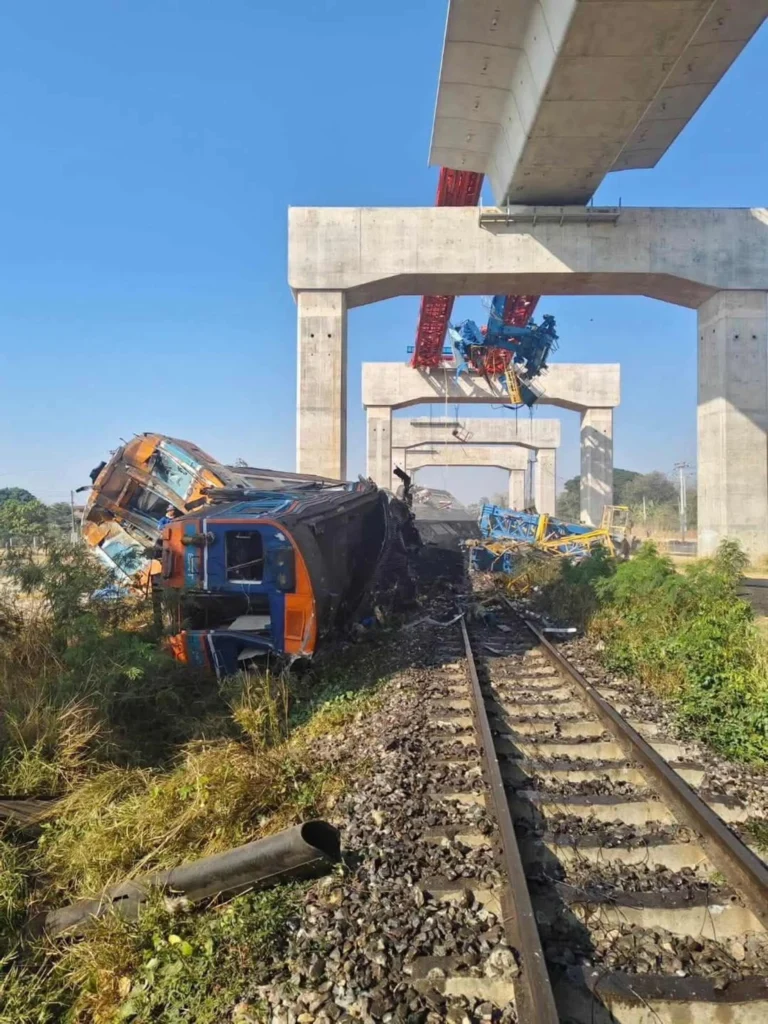
Rescuers and emergency personnel from across the province were deployed to the scene, where they faced the grim task of extricating passengers from mangled metal and overturned carriages. Local authorities confirmed that 195 people were on board at the time of the collision, many of whom were students and local employees. While the death toll has been confirmed at 22, some regional reports suggest the number of fatalities could rise as search operations continue through the wreckage. At least 64 individuals were transported to nearby hospitals, with several reported to be in critical condition. Witness accounts from local residents described hearing two loud explosions followed by plumes of dark smoke rising from the construction site, which is part of a multi-billion dollar Thai-Chinese high-speed rail network intended to link Bangkok to Kunming.
The section of the railway where the collapse occurred was reportedly under the management of Italian-Thai Development (ITD), one of Thailand’s largest construction firms. Transport Minister Phiphat Ratchakitprakarn has ordered an immediate and comprehensive investigation into the cause of the failure, while all construction activities on the high-speed line have been suspended indefinitely. Initial assessments suggest that the crane may have been improperly secured or suffered a structural failure while lifting a heavy concrete slab. This tragedy marks another dark chapter for the project, following a 2024 tunnel collapse in the same province that killed three workers. In response to the outcry over safety standards, the Ministry of Transport has vowed to hold the responsible parties accountable and to conduct a full audit of all heavy machinery operating near active transit corridors.
The international community has expressed condolences to the families of the victims as the Thai government works to identify the deceased and provide support to the survivors. The accident has once again brought the nation’s industrial safety regulations into sharp focus, as critics point to a history of recurring accidents at major infrastructure sites. As the recovery effort concludes, the focus will shift to the technical inquiry led by the Department of Rail Transport and the Engineering Institute of Thailand. For now, the railway line between Bangkok and the northeast remains closed, with bus bridges established to transport stranded travelers while crews work to clear the heavy debris and repair the damaged tracks.