
Trump Rules Out Force in Greenland Bid but Renews
Trump Greenland tariff threats 2026
During a high-profile address at the World Economic Forum in Davos on Wednesday, January 21, 2026, President Donald Trump clarified his administration’s stance on the escalating Greenland crisis. For the first time, the President explicitly ruled out the use of military force to acquire the territory, describing it as a “big, beautiful piece of ice” that the United States is seeking to purchase through “immediate negotiations.” Trump emphasized that while the U.S. has the “excessive strength” to be unstoppable, he does not intend to use it, attempting to quell international fears of a forced annexation. He insisted that U.S. ownership is a logistical and psychological necessity for Arctic defense, arguing that “you can’t defend it on a lease” and claiming the island is geographically “part of North America.”
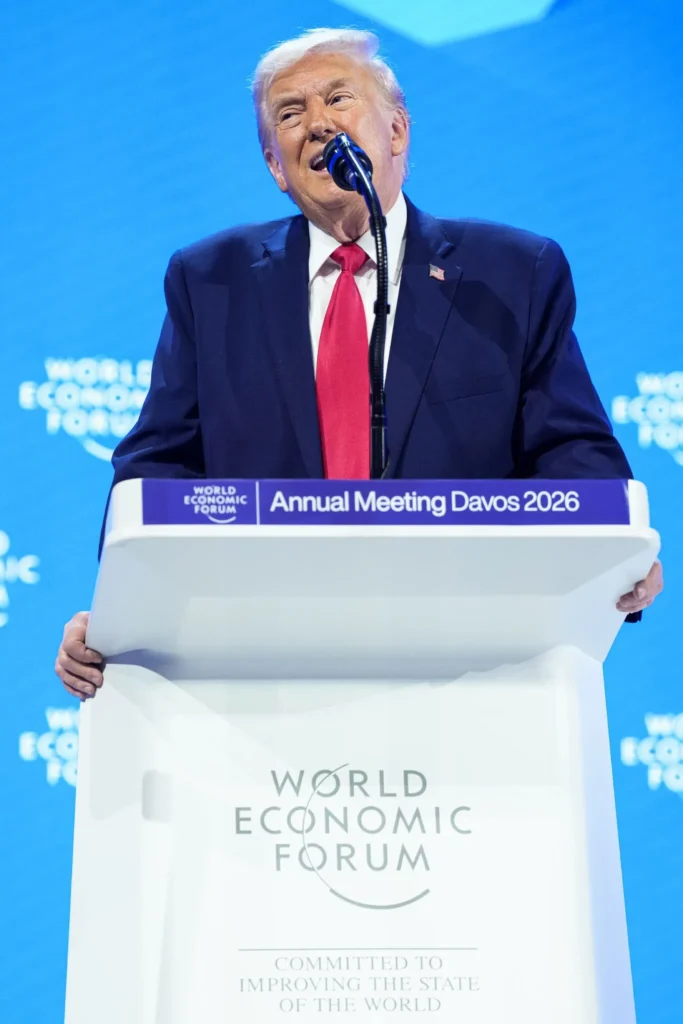
Despite the softened military rhetoric, the President reinforced his aggressive economic leverage. He confirmed that a 10% import tariff will proceed on February 1, 2026, against eight European nations—Denmark, Norway, Sweden, France, Germany, the United Kingdom, the Netherlands, and Finland—that have opposed the sale or participated in symbolic military exercises on the island. Trump warned that these duties would increase to 25% by June 1 if a deal is not reached. In a series of disparaging remarks toward NATO allies, he suggested that without the United States, Europe would “all be speaking German, or a little Japanese,” and questioned whether NATO would reciprocate the U.S. commitment to collective security if American interests were at stake.
The European response at Davos has been one of unified defiance. European Commission President Ursula von der Leyen labeled the tariff threat a “mistake” that risks a “downward spiral” in transatlantic relations. French President Emmanuel Macron and British Prime Minister Keir Starmer have both condemned the tactics as “blackmail” and “completely wrong,” with Macron hinting that the EU may deploy its “anti-coercion instrument”—commonly known as the trade bazooka—for the first time against the United States. Meanwhile, Greenlandic Prime Minister Jens-Frederik Nielsen reiterated that the island is not for sale, stating that the respect for international law is “not a game.”
As global markets remain volatile and gold hits record highs amid the uncertainty, the standoff has shifted from a military concern to a full-scale trade confrontation. Treasury Secretary Scott Bessent has urged allies to “take a deep breath” and let the tensions play out, even as the administration links its aggressive posture to grievances such as the President not receiving the Nobel Peace Prize. With the February 1 deadline approaching, the focus now turns to whether the European Union will move forward with retaliatory tariffs on billions of euros’ worth of U.S. goods or if a diplomatic off-ramp can be found during the remaining bilateral meetings in Davos.