

Global Stocks Plunge as Israel-US Strikes
Global stock market crash Israel Iran conflict 2026
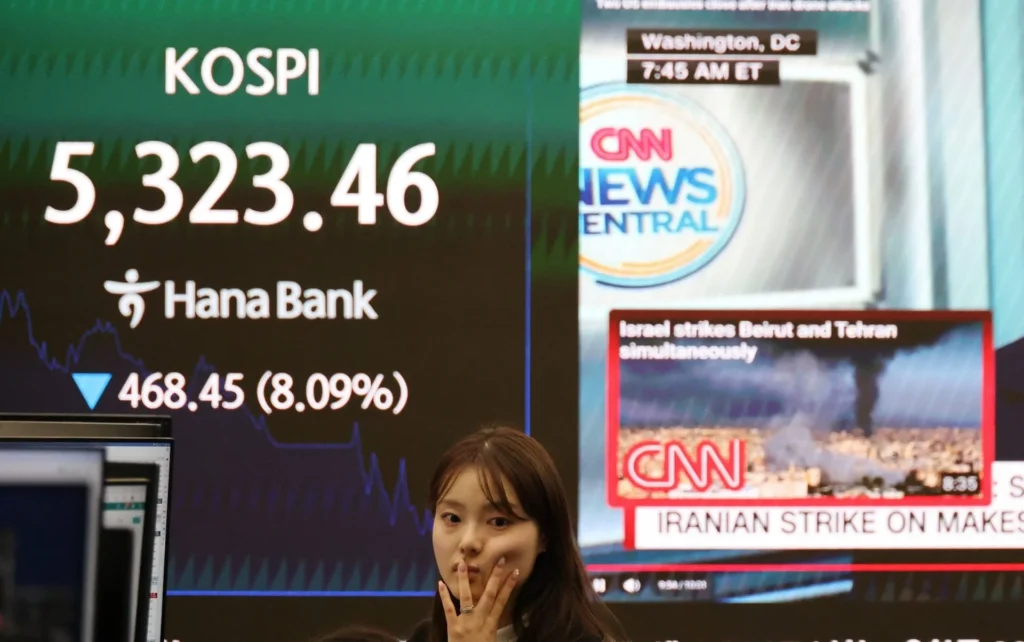
Global financial markets were gripped by panic on Wednesday as Israel and the United States intensified their aerial campaign against Iran, entering the fifth day of a conflict that has severely disrupted energy supplies. In Asia, South Korea’s benchmark Kospi index led a regional rout, plunging as much as 12% and triggering a “sell-side sidecar” to suspend trading for a second consecutive day. Japan’s Nikkei 225 briefly shed 3.9%, while markets in Dubai and Abu Dhabi fell 4.7% and 3.5%, respectively, during their first trading sessions since the weekend strikes began. The massive sell-off followed a volatile Tuesday on Wall Street, where the Dow Jones Industrial Average plummeted over 1,000 points in intraday trading before paring some losses to close down 0.8%. Investors are fleeing to safe-haven assets like gold and the U.S. dollar as fears grow that the “effectively closed” Strait of Hormuz will trigger a sustained global energy crisis.
The primary catalyst for the market turmoil is the near-total shutdown of the Strait of Hormuz, a critical waterway through which 20% of the world’s oil and liquefied natural gas (LNG) flows. Iran’s Revolutionary Guard has reportedly warned all vessels against passage, prompting a buildup of tankers and a 30% surge in natural gas prices. Brent crude, the international benchmark, climbed another 1.4% on Wednesday to reach $82.57 per barrel, its highest level since January 2025. Despite President Donald Trump’s suggestion that the U.S. Navy could escort oil tankers through the strait, market analysts remain skeptical of a quick resolution. According to The Guardian, the effective blockade has already forced Iraq to cut its oil output by nearly 1.5 million barrels a day due to storage limits and a lack of export routes.
The economic fallout is extending beyond the energy sector, as the spike in fuel costs threatens to reignite global inflation and halt planned interest rate cuts. In the United Kingdom, money markets now see only a 29% chance of a Bank of England rate cut in March, down from 80% just last week. Goldman Sachs CEO David Solomon cautioned on Wednesday that it may take “a couple of weeks” for investors to fully digest the long-term implications of the U.S.-led military operation. As reported by Xinhua, analysts warn that a protracted conflict could deal a permanent blow to global trade and equity markets if energy infrastructure remains under fire. This financial instability mirrors the domestic tension in the U.S., following Hillary Clinton’s defiant deposition and the historic conviction of Colin Gray in Georgia.
While some contrarian investors view the current dip as a buying opportunity, most institutional firms are urging extreme caution. The International Monetary Fund (IMF) stated on Tuesday that the “volatility in financial markets” adds to an “already uncertain” global environment, with the ultimate impact depending on the duration of the war. As the U.S. military claims to have “severely degraded” Iranian air defenses and destroyed hundreds of missiles, the focus remains on Tehran’s potential for a massive, non-conventional retaliatory strike. For those tracking live market data, the volatility is expected to continue through the week as the March 19 central bank meetings approach. This story breaks alongside other major reports, such as the stunning results of the Texas primaries and the identifications of four soldiers killed in Kuwait.