

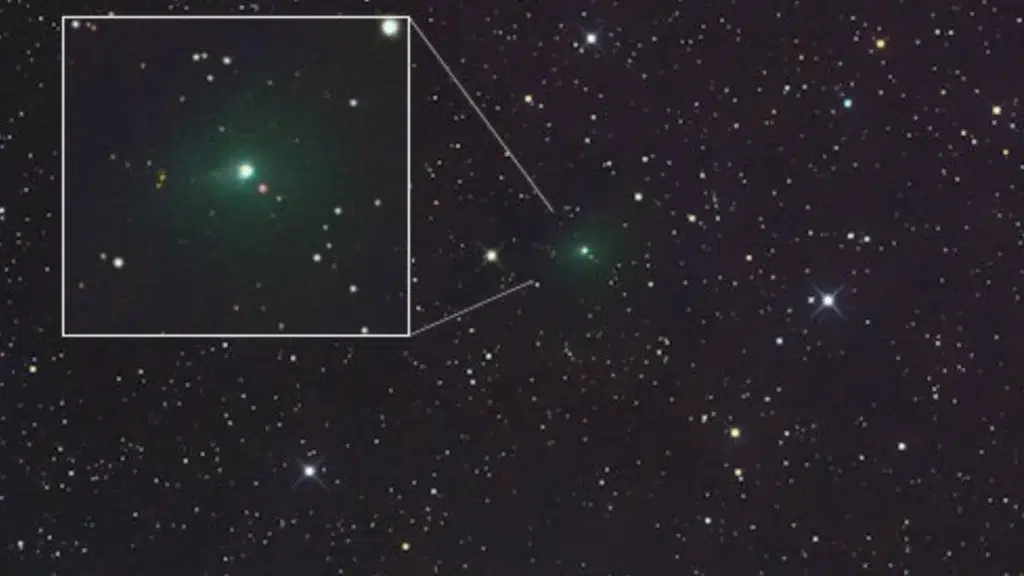
Exclusive: Interstellar comet 3I/ATLAS approaches solar system
Astronomers are closely tracking 3I/ATLAS, a newly identified interstellar comet entering our solar system from beyond. The object was discovered on July 1, 2025, by the ATLAS survey telescope in Chile and has since revealed surprising characteristics.
Unlike most comets, 3I/ATLAS began showing signs of outgassing and forming a visible coma and tail while still far from the Sun—well beyond Jupiter’s orbit. Scientists say this early activity suggests it contains volatile compounds such as carbon dioxide in amounts far greater than typical for solar system comets.
Its trajectory is hyperbolic, meaning it is not gravitationally bound to our Sun and is passing through our system on a one-time journey. It is expected to reach its closest approach to the Sun—known as perihelion—on October 29, 2025, at a distance of about 1.4 astronomical units (just inside Mars’s orbit).
Later, in December, it will make its closest approach to Earth—approximately 170 million miles away—before it continues its outbound path back into interstellar space.
Recent observations from the Gemini South telescope in Chile have captured the comet’s tail growing more prominent, and its coma expanding as solar radiation heats its surface.
Hubble Telescope imaging has refined estimates of 3I/ATLAS’s nucleus diameter to between 0.3 and 3.5 miles (0.5 to 5.6 kilometers), though uncertainty remains due to the brightness of its surrounding coma.
Scientists are also intrigued by the comet’s chemical signature. It shows an unusually high ratio of carbon dioxide to water ice, hinting at different formation conditions than comets from within our solar system.
Because observations of interstellar objects are rare—so far only two others have been confirmed (1I/‘Oumuamua and 2I/Borisov)—3I/ATLAS offers a rare chance to study material from beyond our solar system. Astronomers are using ground and space telescopes to gather as much data as possible while it remains visible.