

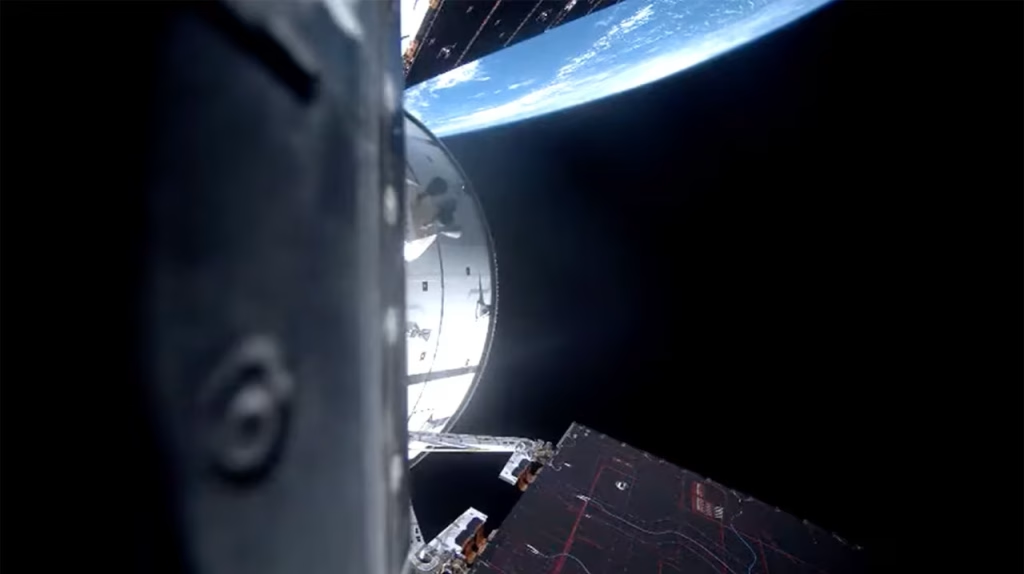
Artemis II Rockets Toward the Moon
Artemis II launch April 2026
Fifty-four years after the final Apollo mission, humanity is officially back on the path to the Moon. On Wednesday, April 1, 2026, at 6:35 p.m. EDT, NASA’s Space Launch System (SLS)—the most powerful rocket ever built—ignited the evening sky over Florida’s Space Coast, propelled by 8.8 million pounds of thrust. The Artemis II mission is now successfully underway, carrying a crew of four inside the Orion spacecraft for a 10-day test flight that will take them further into deep space than any human has traveled in over half a century.

The launch from Kennedy Space Center’s Pad 39B went off without a hitch, despite minor concerns earlier in the week regarding a liquid hydrogen leak. “To the Artemis II crew: You are carrying the dreams of a planet,” Mission Control announced just moments before liftoff. For those following the live telemetry of the SLS ascent, the mission represents a critical “stress test” of NASA’s deep-space hardware before the scheduled Artemis III lunar landing in 2027.
A Crew of “Firsts”
While the hardware is impressive, the heartbeat of Artemis II is its diverse crew, representing a major shift in the demographic of lunar explorers. The four astronauts selected for this “free-return” trajectory mission include:
- Commander Reid Wiseman: A veteran of the International Space Station, leading the first lunar mission of the 21st century.
- Pilot Victor Glover: Making history as the first person of color to leave Earth’s orbit and head toward the Moon.
- Mission Specialist Christina Koch: The record-holding astronaut who is now the first woman assigned to a lunar mission.
- Mission Specialist Jeremy Hansen: Representing the Canadian Space Agency (CSA) as the first non-American to voyage to the lunar far side.

Mission Status: Earth Orbit and Beyond
As of Thursday morning, April 2, the Orion capsule is currently in a High Earth Orbit (HEO). The crew is spending their first 24 hours performing a series of “proximity operations,” testing the spacecraft’s manual handling and life-support systems.
Later today, the crew will execute the Translunar Injection (TLI) burn. This engine fire will break them out of Earth’s gravity and set them on a course for a lunar flyby. According to flight path projections from the Jet Propulsion Laboratory, Orion will reach the Moon on Monday, April 6. At the mission’s furthest point, the crew will be roughly 230,000 miles from Earth, swinging 4,700 miles behind the lunar far side before the Moon’s gravity naturally pulls them back toward home.
The mission is expected to conclude on April 11 with a high-speed reentry into Earth’s atmosphere and a splashdown in the Pacific Ocean. While the world watches, the Artemis II crew is already sending back high-definition footage of the receding Earth—a “blue marble” view that hasn’t been seen by human eyes in person since 1972.
Click Here for more Top News.