

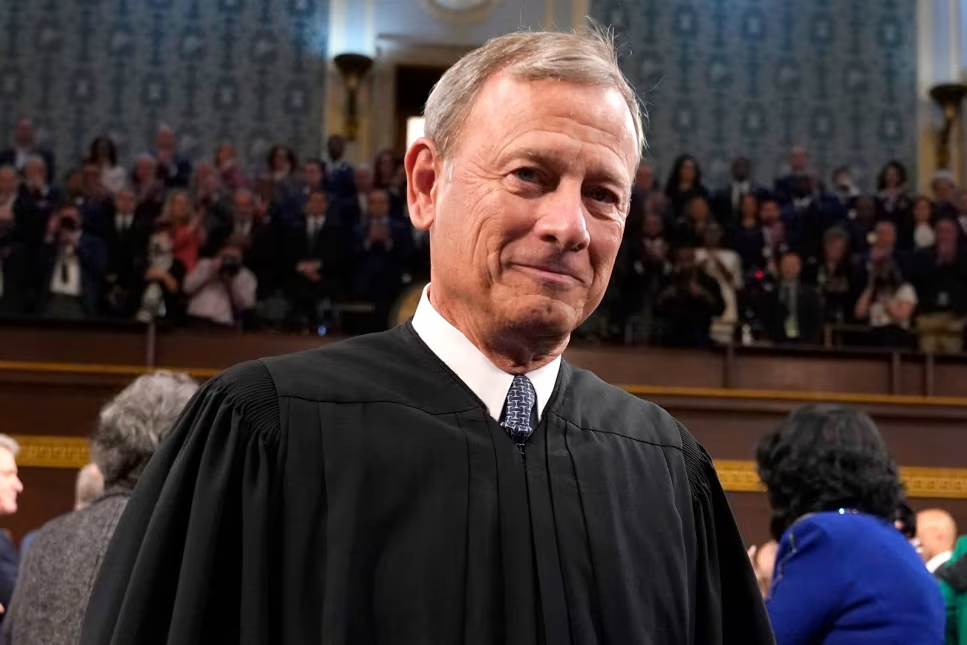
Roberts Legacy Cemented as Voting Rights Act Gutted
Chief Justice John Roberts race protections legacy
legal scholars describe as the defining moment of his judicial career on Wednesday following a landmark Supreme Court ruling that further dismantled federal race protections. In a 6-3 decision in the case of Callais v. Louisiana, the conservative majority struck down a newly drawn congressional map that had featured a second majority-Black district.
The ruling effectively guts Section 2 of the Voting Rights Act by imposing a stricter requirement for plaintiffs to prove intentional discrimination rather than just discriminatory effects. Chief Justice Roberts, who has long advocated for a colorblind interpretation of the Constitution, authored a concurring opinion that reaffirmed his belief that the government must stop sorting citizens by race to achieve political outcomes.
He famously described the contested Louisiana district as a “snake” that prioritized racial demographics over traditional redistricting principles like compactness and community interest. This decision is viewed as the culmination of a decades-long effort by Roberts to roll back the central pillars of the 1965 civil rights law.
The Callais ruling follows a consistent trajectory for the Roberts Court, which began a significant shift in 2013 with the Shelby County v. Holder decision that eliminated federal preclearance for state voting changes. Last year, Roberts further cemented this legacy by leading the majority to end race-conscious admissions in higher education through the Students for Fair Admissions v. Harvard case.
Legal analysts note that the Chief Justice has successfully transitioned the federal judiciary away from race-based remedies and toward a standard of formal equality that ignores historical context. Proponents of this shift argue that the decision restores fairness to the electoral process and prevents the use of race as a tool for partisan advantage.
However, civil rights advocates warn that the removal of these protections leaves minority voters vulnerable to sophisticated map-making techniques that dilute their collective influence. The ruling provides immediate license for legislative bodies to prioritize partisan goals in upcoming redistricting cycles with significantly less fear of federal interference.
The political and legal fallout from Wednesday’s decision is expected to reshape the American electoral landscape ahead of the 2026 midterm elections. Justice Elena Kagan led the liberal minority in a scathing dissent, arguing that the majority has essentially rendered the Voting Rights Act a “dead letter” by raising the bar for legal challenges to an unreachable level.
The decision directly impacts the balance of power in Congress, as it allows Republican-led legislatures to eliminate districts that were previously protected to ensure minority representation. Congressional leaders have already pledged to pursue legislative remedies, including the John Lewis Voting Rights Act, though such efforts face steep hurdles in a divided Capitol.
As the nation grapples with the implications of a diminished Voting Rights Act, the legacy of Chief Justice John Roberts remains firmly tied to the systematic reduction of race-conscious federal oversight. For comprehensive legal analysis and additional details on the ruling, you can visit AP News and The Guardian.