
Asia’s Economy Braces for Historic Iran War Shocks
Iran war impact Asian economy 2026
The escalation of the 2026 Iran war has triggered an unprecedented economic crisis across Asia as the closure of the Strait of Hormuz chokes off vital energy supplies. Financial analysts report that the region is the most vulnerable to this disruption because China, India, Japan, and South Korea account for nearly seventy-five percent of Middle Eastern oil exports. Following the total shutdown of the shipping lane on March 4, Brent crude prices surged past one hundred twenty dollars per barrel.
This sudden spike has forced several national governments to implement emergency energy conservation measures to protect their domestic reserves. The International Energy Agency has officially characterized this situation as the largest supply disruption in the history of the global oil market. You can find more details regarding the initial market reaction and energy volatility through our continuous data tracking.
The economic damage extends far beyond crude oil as the region faces a catastrophic shortage of liquefied natural gas and industrial fertilizers. An attack on the Ras Laffan Industrial City in Qatar has reduced that nation’s gas production capacity by seventeen percent and led to a declaration of force majeure on all export contracts. Consequently, spot prices for natural gas in Asian markets have skyrocketed by over one hundred forty percent in just a few weeks.
Furthermore, the maritime blockade has suspended roughly forty percent of the global trade in nitrogen fertilizer which is vital for the spring planting season. This disruption poses a direct threat to food security in South Asia where agricultural sectors are already struggling with rising input costs and supply chain bottlenecks. For a deeper analysis of the disruption to global gas and fertilizer markets, please visit our resource center.
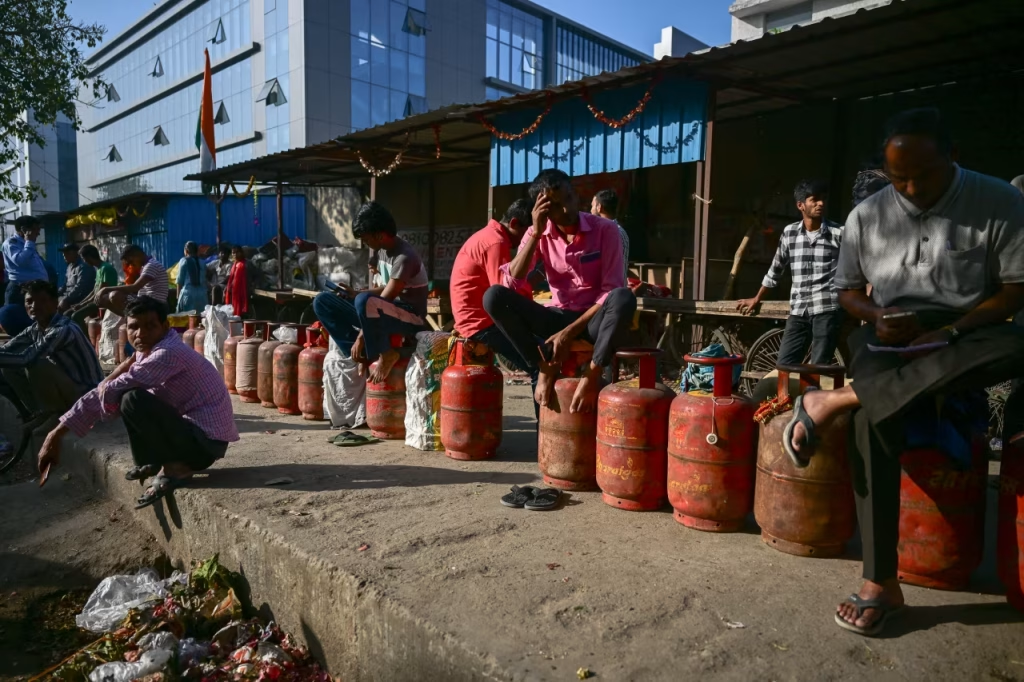
Daily life in major Asian metropolitan areas is being fundamentally altered as the cost of the conflict filters down to businesses and households. In India, the Restaurant Association has reported that thousands of establishments are shrinking menus or switching to wood fire cooking due to the scarcity of commercial LPG. The Philippines has officially adopted a four-day work week to reduce national electricity consumption while Sri Lanka has introduced strict petrol rationing at the pump.
Aviation and shipping industries are also grappling with jet fuel and diesel prices that have more than doubled since the start of Operation Epic Fury. These combined pressures are fueling fears of a prolonged period of stagflation that could push the entire continent into a deep recession. Readers can follow our live updates on the economic shocks rippling across the globe through our specialized crisis monitoring feed.