Second Spanish Passenger from Hantavirus-Stricken Cruise Ship Tests Positive in Madrid
A Spanish national who was evacuated from a disease-ridden luxury cruise ship earlier this month has tested positive for hantavirus while undergoing precautionary isolation at a military hospital in Madrid. Spain’s Health Ministry confirmed the diagnosis on Monday, noting that the patient is the second individual to test positive among the cohort of 14 Spanish citizens who were repatriated from the vessel. Upon confirmation of the active infection, the patient was immediately transferred to a specialized high-level isolation unit inside the Gómez Ulla Military Hospital. Health officials emphasized that because the individual was already strictly isolated from the public as a safety measure, the new positive result does not alter or elevate the virus risk level for the general population.
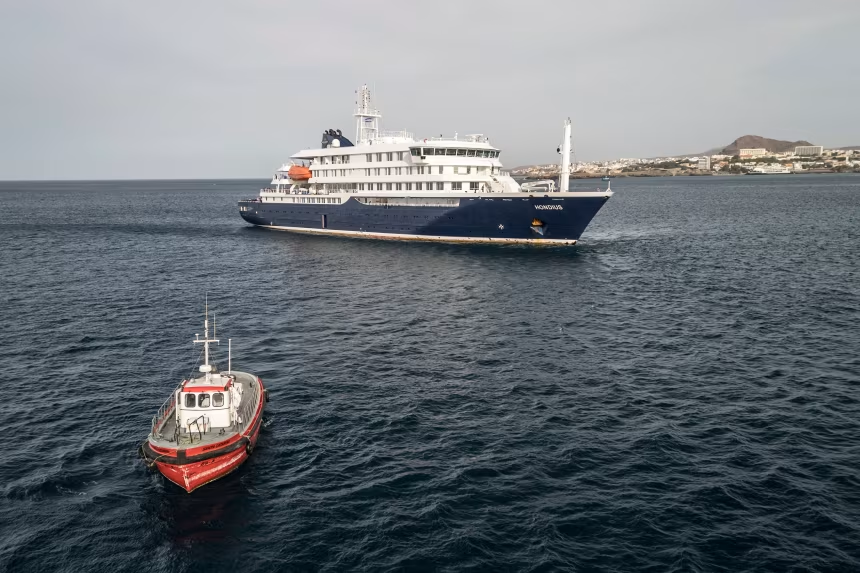
The case is directly tied to an international public health emergency that broke out aboard the Dutch-flagged vessel MV Hondius. The luxury liner was carrying roughly 150 passengers and crew from 23 different countries when a cluster of severe acute respiratory illnesses was first reported to the World Health Organization (WHO) on May 2. Public health agencies have since identified the pathogen as the Andes hantavirus strain. While hantaviruses are typically contracted via contact with infected rodent droppings or urine, the Andes variant is uniquely dangerous because it is the only known hantavirus strain capable of human-to-human transmission. Investigators believe an index patient contracted the virus on land in South America before boarding the ship when it departed Ushuaia, Argentina, on April 1, allowing the pathogen to quietly circulate in the closed environment.
The ship was eventually intercepted, and an international evacuation mission began when the MV Hondius anchored near Tenerife in the Canary Islands on May 10. Passengers were systematically removed, grouped by nationality, and flown back to their respective home countries to serve out mandatory quarantine periods. To date, the cruise ship outbreak has infected a total of 12 people globally and claimed three lives: a Dutch couple and a German national. The long incubation window for the Andes virus—which typically spans four to six weeks before symptoms manifest—means that sporadic positive cases among the isolated travelers are fully expected by epidemiologists. The Public Health Agency of Canada similarly confirmed that a Canadian passenger isolating in British Columbia tested positive last week.
While the MV Hondius has since docked in Rotterdam to undergo extensive decontamination, international contact tracing remains heavily underway. Health authorities are actively monitoring dozens of flight contacts across Europe and Africa who shared commercial plane cabins with early patients before the full scope of the cruise ship outbreak was realized. The Andes hantavirus triggers Hantavirus Cardiopulmonary Syndrome (HCPS), a severe illness marked by high fever, severe muscle aches, and gastrointestinal distress that can rapidly progress to respiratory failure and shock. Because the virus carries a high case-fatality rate, health ministries are maintaining rigorous isolation protocols, though the WHO maintains that the overall risk to the broader global public remains low.